


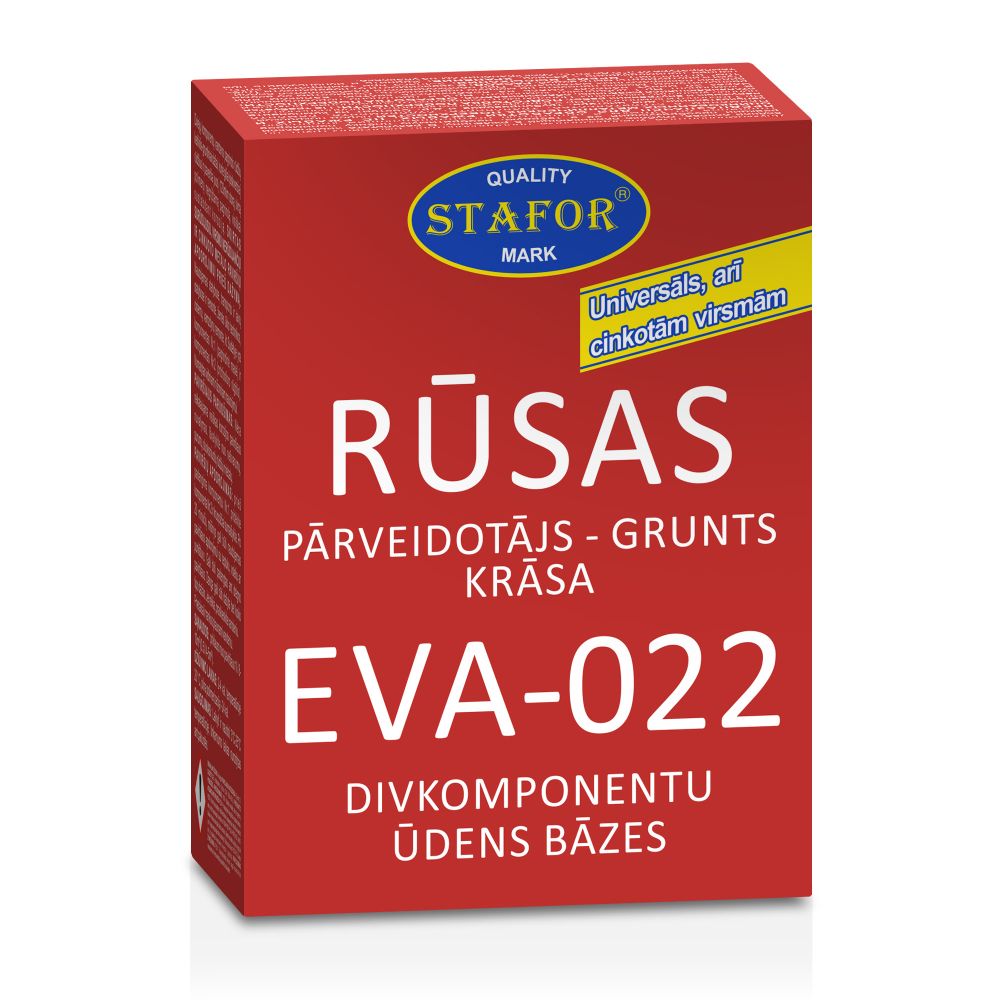
EVA 022 rust converter-primer UNIVERSAL
A two-component water-emulsion universal rust converter primer that penetrates deep into rust and converts it into a solid, irreversible polymer layer up to 120 microns thick, completely stopping corrosion. Designed for treating rusting, non-rusting and galvanised metal surfaces before painting. Used in construction, transport or shipbuilding and repair, repair of agricultural machinery, tanks, pipelines, etc. Consists of component No. 1 (base mass) and component No. 2 (orthophosphoric acid). Designed for indoor and outdoor use.
SURFACE PREPARATION: Complete cleaning of the surface from corrosion is not required. The surface must be cleaned of dirt, loose, flaking rust and degreased. Painted surfaces must be treated with sandpaper to improve adhesion.
SURFACE TREATMENT: Before application, add component No. 2 to component No. 1 and mix thoroughly. After 20 minutes, the mixture can be applied to the surface with a brush, roller or spray. Stir the product regularly during application. Can be applied to damp surfaces. The coating can be painted with any paint. Can be diluted with water if necessary. Wash tools and hands with water.
AUTOSPECI.LV RECOMMENDS!
HIGH-QUALITY ANTI-FUNGAL TREATMENT +371 29510016
COVERAGE: Depending on the surface, 1 litre/8-10 m² (0.5 litres/4-5 m²).
SETTING TIME: 2-4 hours at 20 °C, complete polymerisation – 24 hours.
STORAGE: Store and use at temperatures between 3°C and 25°C. The expiry date is indicated on the packaging.
INSTRUCTIONS FOR USE:
Type and action: A two-component water-based polymer system that converts corrosion products, completely stops the corrosion process, creating a durable coating (primer), stains are allowed (depending on the intensity of rust). Consists of a base compound with effective additives capable of deeply penetrating thick layers of rust, and orthophosphoric acid. A layer of phosphates up to 20 μm thick forms on the metal surface. The total thickness of the coating depends on the thickness of the corrosion layer, from 30 microns on clean metal to 120 microns on rusty metal.
As a result of polymerisation, the rust layer up to 120 microns thick is transformed into a solid, irreversible film that can be repainted with any type of paint — perchlorovinyl, polyvinyl chloride, epoxy, polyester, polyurethane, alkyd, silicone, oil, nitrocellulose water emulsions, bitumen and other paint and varnish materials. After treatment (without top coat), no re-formation of rust under atmospheric conditions was observed on test samples for 5 years.
Application: Designed for treating rusty metal surfaces in building structures, motor vehicles, shipbuilding and repair, rail transport, bridge construction, tank repair, pipelines , tin roofs, as well as posts, fences, gates, doors, drainpipes, metal garden furniture, park equipment, etc. before painting. Used for exterior and interior work. CAN BE USED ON CLEAN METAL, OLD COATINGS, GALVANISED SURFACES.
Surface preparation: No laborious and expensive surface treatment (sandblasting, etc.) is required to completely remove corrosion products. The surface is cleaned of dirt, loose, flaking rust using a hand metal brush or electric hand tools. If the surface is oily, degrease it with a solvent; if it is not oily, degrease it with a soap solution. Can be applied to damp surfaces. If there is a layer of previously applied paint on the surface, it must be treated with sandpaper to improve adhesion.
Application: Before use, add 5-7% by weight of orthophosphoric acid to the main mass, mix thoroughly, leave for up to 20 minutes, then treat the rusty surface with the finished mixture using a brush, roller or paint sprayer. After 2 hours (+20ºC), the rusting process stops completely. Complete polymerisation, depending on air temperature and atmospheric humidity, occurs within 2-15 hours. Avoid priming if the surface is exposed to direct sunlight, as corrosion products may not be completely converted due to excessive drying. When working outdoors, keep in mind that the work should be done in such a way that complete polymerisation occurs before it starts raining, otherwise the composition will be washed off the treated surface. The composition must be applied to 100% of the entire surface to be treated. The coating must be applied to 100% of the entire surface to be treated. Good results are achieved when using epoxy-based paint materials as a coating.
Dilute with water if necessary. Wash tools and hands with water. Does not harm the environment, is non-flammable and non-explosive.